Detector distortion corrections#
This tutorial shows how to correct images for spatial distortion. Some tutorial examples rely on files available in http://www.silx.org/pub/pyFAI/testimages/ and will be downloaded during this tutorial.
Detector definitions#
pyFAI features an impressive list of 110 detector definitions contributed often by manufacturers and some other reverse engineered by scientists. Each of them is defined as an individual class which contains a way to calculate the mask (invalid pixels, gaps,…) and a method to calculate the pixel positions in Cartesian coordinates.
import time
import os
import copy
import numpy
import pyFAI
import pyFAI.detectors

start_time = time.perf_counter()
print(f"pyFAI version: {pyFAI.version}")
all_detectors = list(set(pyFAI.detectors.ALL_DETECTORS.values()))
#Sort detectors according to their name
all_detectors.sort(key=lambda i:i.__name__)
nb_det = len(all_detectors)
print("Number of detectors registered: %i with %i unique detectors"%(len(pyFAI.detectors.ALL_DETECTORS),nb_det))
print()
print("List of all supported detectors:")
for i in all_detectors:
    print(i())
pyFAI version: 2026.9.0
Number of detectors registered: 301 with 110 unique detectors

List of all supported detectors:
Detector Quantum 210	 PixelSize= 51µm, 51µm	 BottomRight (3)
Detector Quantum 270	 PixelSize= 51µm, 51µm	 BottomRight (3)
Detector Quantum 315	 PixelSize= 51µm, 51µm	 BottomRight (3)
Detector Quantum 4	 PixelSize= 51µm, 51µm	 BottomRight (3)
Detector Aarhus	 PixelSize= 24.893µm, 24.893µm	 BottomRight (3)
Detector ApexII	 PixelSize= 120µm, 120µm	 BottomRight (3)
Detector aca1300	 PixelSize= 3.75µm, 3.75µm	 BottomRight (3)
Detector CirPAD	 PixelSize= 130µm, 130µm	 BottomRight (3)
Undefined detector
Detector Dexela 2923	 PixelSize= 75µm, 75µm	 BottomRight (3)
Detector Eiger 16M	 PixelSize= 75µm, 75µm	 BottomRight (3)
Detector Eiger 1M	 PixelSize= 75µm, 75µm	 BottomRight (3)
Detector Eiger2 CdTe 16M	 PixelSize= 75µm, 75µm	 BottomRight (3)
Detector Eiger2 CdTe 1M	 PixelSize= 75µm, 75µm	 BottomRight (3)
Detector Eiger2 CdTe 1M-W	 PixelSize= 75µm, 75µm	 BottomRight (3)
Detector Eiger2 CdTe 2M-W	 PixelSize= 75µm, 75µm	 BottomRight (3)
Detector Eiger2 CdTe 4M	 PixelSize= 75µm, 75µm	 BottomRight (3)
Detector Eiger2 CdTe 500k	 PixelSize= 75µm, 75µm	 BottomRight (3)
Detector Eiger2 CdTe 9M	 PixelSize= 75µm, 75µm	 BottomRight (3)
Detector Eiger2 16M	 PixelSize= 75µm, 75µm	 BottomRight (3)
Detector Eiger2 1M	 PixelSize= 75µm, 75µm	 BottomRight (3)
Detector Eiger2 1M-W	 PixelSize= 75µm, 75µm	 BottomRight (3)
Detector Eiger2 250k	 PixelSize= 75µm, 75µm	 BottomRight (3)
Detector Eiger2 2M-W	 PixelSize= 75µm, 75µm	 BottomRight (3)
Detector Eiger2 4M	 PixelSize= 75µm, 75µm	 BottomRight (3)
Detector Eiger2 500k	 PixelSize= 75µm, 75µm	 BottomRight (3)
Detector Eiger2 9M	 PixelSize= 75µm, 75µm	 BottomRight (3)
Detector Eiger 4M	 PixelSize= 75µm, 75µm	 BottomRight (3)
Detector Eiger 500k	 PixelSize= 75µm, 75µm	 BottomRight (3)
Detector Eiger 9M	 PixelSize= 75µm, 75µm	 BottomRight (3)
Detector FReLoN	 PixelSize= 50µm, 50µm	 BottomRight (3)
Detector Fairchild	 PixelSize= 15µm, 15µm	 BottomRight (3)
Detector HF-130k	 PixelSize= 150µm, 150µm	 BottomRight (3)
Detector HF-1M	 PixelSize= 150µm, 150µm	 BottomRight (3)
Detector HF-262k	 PixelSize= 150µm, 150µm	 BottomRight (3)
Detector HF-2.4M	 PixelSize= 150µm, 150µm	 BottomRight (3)
Detector HF-4M	 PixelSize= 150µm, 150µm	 BottomRight (3)
Detector HF-9.4M	 PixelSize= 150µm, 150µm	 BottomRight (3)
Detector Imxpad S10	 PixelSize= 130µm, 130µm	 BottomRight (3)
Detector Imxpad S140	 PixelSize= 130µm, 130µm	 BottomRight (3)
Detector Imxpad S70	 PixelSize= 130µm, 130µm	 BottomRight (3)
Detector Imxpad S70 V	 PixelSize= 130µm, 130µm	 BottomRight (3)
Detector Jungfrau 500k	 PixelSize= 75µm, 75µm	 BottomRight (3)
Detector Jungfrau 1M	 PixelSize= 75µm, 75µm	 BottomRight (3)
Detector Jungfrau 4M	 PixelSize= 75µm, 75µm	 BottomRight (3)
Detector Jungfrau 8M	 PixelSize= 75µm, 75µm	 BottomRight (3)
Detector Jungfrau 16M cor	 PixelSize= 75µm, 75µm	 BottomRight (3)
Detector Lambda 10M	 PixelSize= 55µm, 55µm	 BottomRight (3)
Detector Lambda 250k	 PixelSize= 55µm, 55µm	 BottomRight (3)
Detector Lambda 2M	 PixelSize= 55µm, 55µm	 BottomRight (3)
Detector Lambda 60k	 PixelSize= 55µm, 55µm	 BottomRight (3)
Detector Lambda 750k	 PixelSize= 55µm, 55µm	 BottomRight (3)
Detector Lambda 7.5M	 PixelSize= 55µm, 55µm	 BottomRight (3)
Detector Lambda 9M	 PixelSize= 55µm, 55µm	 BottomRight (3)
Detector MAR 345	 PixelSize= 100µm, 100µm	 BottomRight (3)
Detector MAR 555	 PixelSize= 139µm, 139µm	 BottomRight (3)
Detector Maxipix 1x1	 PixelSize= 55µm, 55µm	 BottomRight (3)
Detector Maxipix 2x2	 PixelSize= 55µm, 55µm	 BottomRight (3)
Detector Maxipix 5x1	 PixelSize= 55µm, 55µm	 BottomRight (3)
Detector Mythen 1280	 PixelSize= 8mm, 50µm	 BottomRight (3)
Detector Perkin detector	 PixelSize= 200µm, 200µm	 BottomRight (3)
Detector Pilatus 100k	 PixelSize= 172µm, 172µm	 BottomRight (3)
Detector Pilatus 1M	 PixelSize= 172µm, 172µm	 BottomRight (3)
Detector Pilatus 200k	 PixelSize= 172µm, 172µm	 BottomRight (3)
Detector Pilatus 2M	 PixelSize= 172µm, 172µm	 BottomRight (3)
Detector Pilatus 300k	 PixelSize= 172µm, 172µm	 BottomRight (3)
Detector Pilatus 300kw	 PixelSize= 172µm, 172µm	 BottomRight (3)
Detector Pilatus4 1M	 PixelSize= 150µm, 150µm	 BottomRight (3)
Detector Pilatus4 260k	 PixelSize= 150µm, 150µm	 BottomRight (3)
Detector Pilatus4 260kw	 PixelSize= 150µm, 150µm	 BottomRight (3)
Detector Pilatus4 2M	 PixelSize= 150µm, 150µm	 BottomRight (3)
Detector Pilatus4 4M	 PixelSize= 150µm, 150µm	 BottomRight (3)
Detector Pilatus4 1M CdTe	 PixelSize= 150µm, 150µm	 BottomRight (3)
Detector Pilatus4 260k CdTe	 PixelSize= 150µm, 150µm	 BottomRight (3)
Detector Pilatus4 260kw CdTe	 PixelSize= 150µm, 150µm	 BottomRight (3)
Detector Pilatus4 2M CdTe	 PixelSize= 150µm, 150µm	 BottomRight (3)
Detector Pilatus4 4M CdTe	 PixelSize= 150µm, 150µm	 BottomRight (3)
Detector Pilatus 6M	 PixelSize= 172µm, 172µm	 BottomRight (3)
Detector Pilatus 900k	 PixelSize= 172µm, 172µm	 BottomRight (3)
Detector Pilatus CdTe 1M	 PixelSize= 172µm, 172µm	 BottomRight (3)
Detector Pilatus CdTe 2M	 PixelSize= 172µm, 172µm	 BottomRight (3)
Detector Pilatus CdTe 300k	 PixelSize= 172µm, 172µm	 BottomRight (3)
Detector Pilatus CdTe 300kw	 PixelSize= 172µm, 172µm	 BottomRight (3)
Detector Pilatus CdTe 900kw	 PixelSize= 172µm, 172µm	 BottomRight (3)
Hexagonal-pixel detector Pixirad-1	 Pitch= 6.000e-05 m
Hexagonal-pixel detector Pixirad-2	 Pitch= 6.000e-05 m
Hexagonal-pixel detector Pixirad-4	 Pitch= 6.000e-05 m
Hexagonal-pixel detector Pixirad-8	 Pitch= 6.000e-05 m
Detector Pixium 4700	 PixelSize= 308µm, 308µm	 BottomRight (3)
Detector RapidII	 PixelSize= 100µm, 100µm	 BottomRight (3)
Detector Picam HQ	 PixelSize= 1.55µm, 1.55µm	 BottomRight (3)
Detector Picam v1	 PixelSize= 1.4µm, 1.4µm	 BottomRight (3)
Detector Picam v2	 PixelSize= 1.12µm, 1.12µm	 BottomRight (3)
Detector Rayonix133	 PixelSize= 64µm, 64µm	 BottomRight (3)
Detector Rayonix LX170	 PixelSize= 44.2708µm, 44.2708µm	 BottomRight (3)
Detector Rayonix LX255	 PixelSize= 44.2708µm, 44.2708µm	 BottomRight (3)
Detector Rayonix MX170	 PixelSize= 44.2708µm, 44.2708µm	 BottomRight (3)
Detector Rayonix MX225	 PixelSize= 73.242µm, 73.242µm	 BottomRight (3)
Detector Rayonix MX225HS	 PixelSize= 78.125µm, 78.125µm	 BottomRight (3)
Detector Rayonix MX300	 PixelSize= 73.242µm, 73.242µm	 BottomRight (3)
Detector Rayonix MX300HS	 PixelSize= 78.125µm, 78.125µm	 BottomRight (3)
Detector Rayonix MX325	 PixelSize= 79.346µm, 79.346µm	 BottomRight (3)
Detector Rayonix MX340HS	 PixelSize= 88.5417µm, 88.5417µm	 BottomRight (3)
Detector Rayonix MX425HS	 PixelSize= 44.2708µm, 44.2708µm	 BottomRight (3)
Detector Rayonix SX165	 PixelSize= 39.5µm, 39.5µm	 BottomRight (3)
Detector Rayonix SX200	 PixelSize= 48µm, 48µm	 BottomRight (3)
Detector Rayonix SX30HS	 PixelSize= 15.625µm, 15.625µm	 BottomRight (3)
Detector Rayonix SX85HS	 PixelSize= 44.2708µm, 44.2708µm	 BottomRight (3)
Detector Titan 2k x 2k	 PixelSize= 60µm, 60µm	 BottomRight (3)
Detector Xpad S540 flat	 PixelSize= 130µm, 130µm	 BottomRight (3)
Defining a detector from a spline file#
For optically coupled CCD detectors, the geometrical distortion is often described by a two-dimensional cubic spline (as in FIT2D) which can be imported into the relevant detector instance and used to calculate the actual pixel position in space (and masked pixels).
At the ESRF, mainly FReLoN detectors [J.-C. Labiche, ESRF Newsletter 25, 41 (1996)] are used with spline files describing the distortion of the fiber optic taper.
Let’s download such a file and create a detector from it. Users at ESRF may declare a proxy to connect to the internet.
from silx.resources import ExternalResources
downloader = ExternalResources("pyFAI", "http://www.silx.org/pub/pyFAI/testimages", "PYFAI_DATA")
spline_file = downloader.getfile("halfccd.spline")
print(spline_file)
/tmp/pyFAI_testdata_kieffer/halfccd.spline
hd = pyFAI.detectors.FReLoN(splinefile=spline_file)
print(hd)
print("Shape: %i, %i"% hd.shape)
Detector FReLoN	 Spline= /tmp/pyFAI_testdata_kieffer/halfccd.spline	 PixelSize= 48.42252µm, 46.84483µm	 BottomRight (3)
Shape: 1025, 2048
Note: the unusual shape of this detector. This is probably a human error when calibrating the detector distortion in FIT2D.
Visualizing the mask#
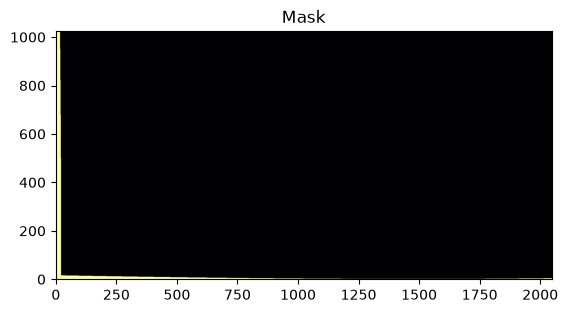
Every detector object contains a mask attribute, defining pixels which are invalid. For FReLoN detector (a spline-files-defined detectors), all pixels having an offset such that the pixel falls out of the initial detector are considered as invalid.
Masked pixels with non-null values can be displayed like this:
# %matplotlib widget
#For documentation purpose, `inline` is used to enforce the storage of the image in the notebook
%matplotlib inline
from matplotlib.pyplot import subplots
from pyFAI.gui import jupyter
jupyter.display(hd.mask, label="Mask")
pass
Detector definition files as NeXus files#
Any detector object in pyFAI can be saved into an HDF5 file following the NeXus convention [Könnecke et al., 2015, J. Appl. Cryst. 48, 301-305.]. Detector objects can subsequently be restored from disk, making complex detector definitions less error prone.
h5_file = "halfccd.h5"
hd.save(h5_file)
new_det = pyFAI.detector_factory(h5_file)
print(new_det)
print("Mask is the same: ", numpy.allclose(new_det.mask, hd.mask))
print("Pixel positions are the same: ", numpy.allclose(new_det.get_pixel_corners(), hd.get_pixel_corners()))
print("Number of masked pixels", new_det.mask.sum())
FReLoN detector from NeXus file: halfccd.h5	 PixelSize= 48.42252µm, 46.84483µm	 BottomRight (3)
Mask is the same:  True
Pixel positions are the same:  True
Number of masked pixels 34382
Pixels of an area detector are saved as a four-dimensional dataset: i.e. a two-dimensional array of vertices pointing to every corner of each pixel, generating an array of dimension (Ny, Nx, Nc, 3), where Nx and Ny are the dimensions of the detector, Nc is the number of corners of each pixel, usually four, and the last entry contains the coordinates of the vertex itself (in the order: Z, Y, X).
This kind of definition, while relying on large description files, can address some of the most complex detector layouts. They will be presented a bit later in this tutorial.
print("Size of Spline-file:", os.stat(spline_file).st_size)
print("Size of Nexus-file:", os.stat(h5_file).st_size)
Size of Spline-file: 1183
Size of Nexus-file: 410431590
The HDF5 file is indeed much larger than the spline file.
Modify a detector and saving#
One may want to define a new mask (or flat-field) for its detector and save the mask with the detector definition. Here, we create a copy of the detector and reset its mask to enable all pixels in the detector and save the new detector instance into another file.
nomask_file = "nomask.h5"
nomask = copy.deepcopy(new_det)
nomask.mask = numpy.zeros_like(new_det.mask)
nomask.save(nomask_file)
nomask = pyFAI.detector_factory("nomask.h5")
print("No pixels are masked: ",nomask.mask.sum())
No pixels are masked: 0
Wrap up
In this section we have seen how detectors are defined in pyFAI, how they can be created, either from the list of the parametrized ones, or from spline files, or from NeXus detector files. We have also seen how to save and subsequently restore a detector instance, preserving the modifications made.
Distortion correction#
Once the position of every single pixel in space is known, one can benefit from the regridding engine of pyFAI adapted to image distortion correction tasks. The pyFAI.distortion.Distortion class is the equivalent of the pyFAI.AzimuthalIntegrator for distortion. Provided with a detector definition, it enables the correction of a set of images by using the same kind of look-up tables as for azimuthal integration.
from pyFAI.distortion import Distortion
dis = Distortion(nomask)
print(dis)
Distortion correction csr on device None for detector shape (1025, 2048):
FReLoN detector from NeXus file: nomask.h5	 PixelSize= 48.42252µm, 46.84483µm	 BottomRight (3)
FReLoN detector#
First load the image to be corrected, then correct it for geometric distortion.
halfccd_img = downloader.getfile("halfccd.edf")
import fabio
raw = fabio.open(halfccd_img).data
cor = dis.correct(raw, dummy=raw.min())

#Then display raw and corrected imagesimages
fig, ax = subplots(2, figsize=(8,8))

jupyter.display(raw, label="Raw Image", ax=ax[0])
jupyter.display(cor, label="Corrected image", ax=ax[1])
pass
WARNING:pyFAI.ext._distortion:Patching image of shape 2048x1024 on expected size of 2048x1025
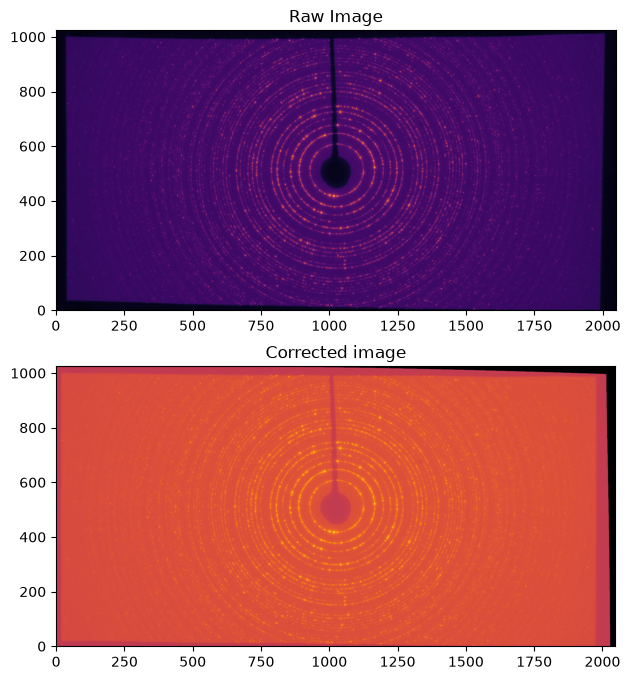
Nota: in this case the image size (1024 lines) does not match the detector’s number of lines (1025) hence pyFAI complains about it. Here, pyFAI patched the image on an empty image of the right size so that the processing can occur.
In this example, the size of the pixels and the shape of the detector are preserved, discarding all pixels falling outside the detector’s grid.
One may want all pixels’ intensity to be preserved in the transformation. By allowing the output array to be large enough to accommodate all pixels, the total intensity can be kept. For this, just enable the “resize” option in the constructor of Distortion:
dis1 = Distortion(hd, resize=True)
cor = dis1.correct(raw)
print(dis1)
print("After correction, the image has a different shape", cor.shape)
WARNING:pyFAI.ext._distortion:Patching image of shape 2048x1024 on expected size of 2048x1025
Distortion correction csr on device None for detector shape (1045, 2052):
Detector FReLoN	 Spline= /tmp/pyFAI_testdata_kieffer/halfccd.spline	 PixelSize= 48.42252µm, 46.84483µm	 BottomRight (3)
After correction, the image has a different shape (1045, 2052)
fig, ax = subplots(2,figsize=(8,8))
jupyter.display(raw, label="Raw Image", ax=ax[0])
jupyter.display(cor, label="Corrected image", ax=ax[1])
pass
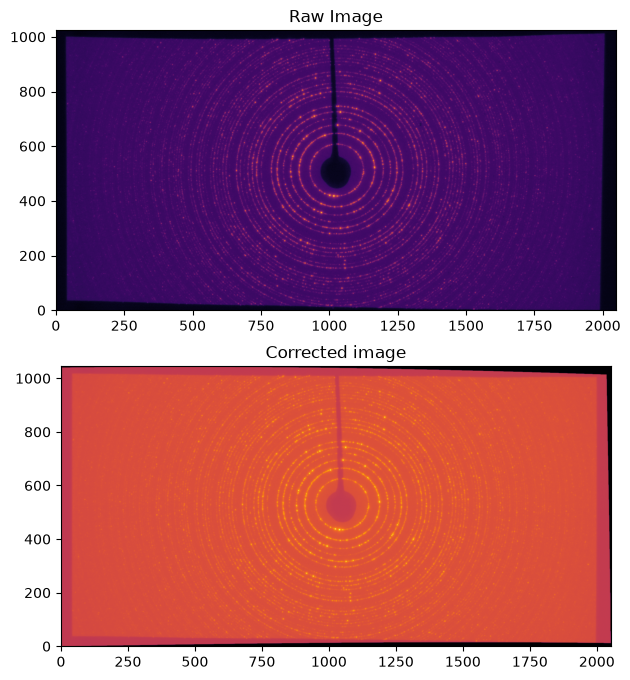
Example of Pixel-detectors:#
XPad Flat detector#
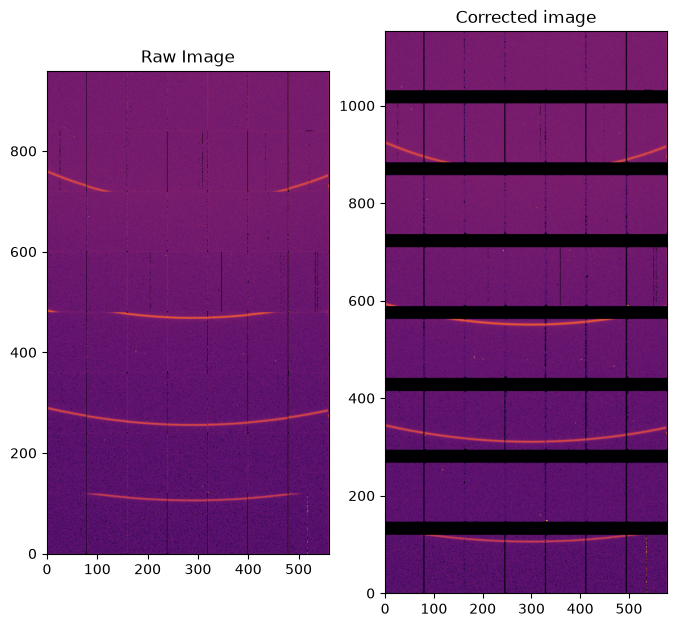
There is a striking example in the cover image of this article: http://scripts.iucr.org/cgi-bin/paper?S1600576715004306 where a detector made of multiple modules is eating up some rings. The first example will be about the regeneration of an “eyes friendly” version of this image.
xpad_file = downloader.getfile("LaB6_18.57keV_frame_13.edf")
xpad = pyFAI.detector_factory("Xpad_flat")
print(xpad)
xpad_dis = Distortion(xpad, resize=True)

raw = fabio.open(xpad_file).data
cor = xpad_dis.correct(raw)
print("Shape as input and output:", raw.shape, cor.shape)
print("Conservation of the total intensity:", raw.sum(dtype="float64"), cor.sum(dtype="float64"))

#then display images side by side
fig, ax = subplots(1, 2, figsize=(8,8))
jupyter.display(raw, label="Raw Image", ax=ax[0])
jupyter.display(cor, label="Corrected image", ax=ax[1])
pass
Detector Xpad S540 flat	 PixelSize= 130µm, 130µm	 BottomRight (3)
Shape as input and output: (960, 560) (1153, 578)
Conservation of the total intensity: 11120798.0 11120797.978917753
WOS XPad detector#
This is a new WAXS opened for SAXS pixel detector from ImXPad (available at ESRF-BM02/D2AM CRG beamline). It looks like two of XPad_flat detectors side by side with some modules shifted in order to create a hole to accommodate a flight-tube which gathers the SAXS photons to a second detector further away.
The detector definition for this specific detector has directly been put down using the metrology information from the manufacturer and saved as a NeXus detector definition file.
wos_det = downloader.getfile("WOS.h5")
wos_img = downloader.getfile("WOS.edf")
wos = pyFAI.detector_factory(wos_det)
print(wos)
wos_dis = Distortion(wos, resize=True)

raw = fabio.open(wos_img).data
cor = wos_dis.correct(raw)
print("Shape as input: {} and output: {}".format( raw.shape, cor.shape))
print("Conservation of the total intensity: {:.4e} vs {:.4e} ".format(raw.sum(dtype="float64"), cor.sum(dtype="float64")))
#then display images side by side
fig, ax = subplots(2, figsize=(8,8))
jupyter.display(raw, label="Raw Image", ax=ax[0])
jupyter.display(cor, label="Corrected image", ax=ax[1])
pass
NexusDetector detector from NeXus file: /tmp/pyFAI_testdata_kieffer/WOS.h5	 PixelSize= 130µm, 130µm	 BottomRight (3)
Shape as input: (598, 1154) and output: (710, 1302)
Conservation of the total intensity: 4.4436e+08 vs 4.4437e+08
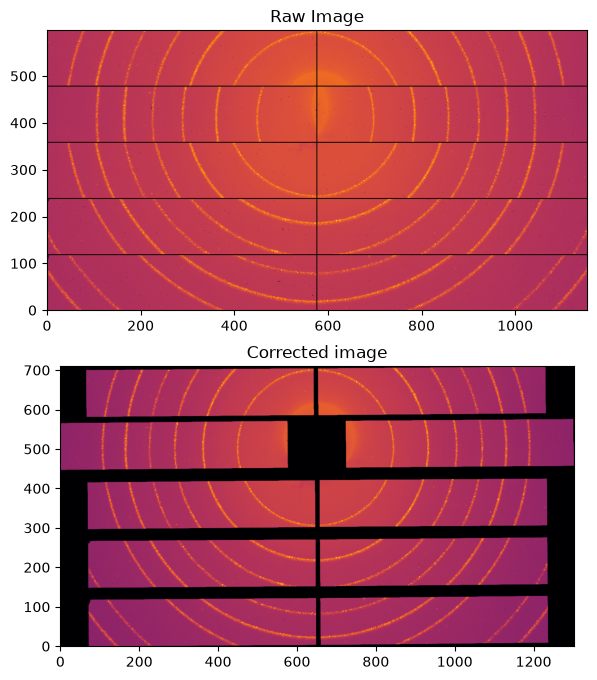
Nota: Do not use this detector definition file to process data from the WOS@D2AM as it has not (yet) been fully validated and may contain some errors in the pixel positioning.
Conclusion#
pyFAI provides a very comprehensive list of detector definitions, is versatile enough to address most area detectors on the market, and features a powerful regridding engine, both combined together into the distortion correction tool which ensures the conservation of the signal during the transformation (the number of photons counted is preserved during the transformation)
Distortion correction should not be used for pre-processing images prior to azimuthal integration as it re-bins the image, thus induces a broadening of the peaks. The AzimuthalIntegrator object performs all this together with integration, it has hence a better precision.
This tutorial did not answer the question how to calibrate the distortion of a given detector ? which is addressed in another tutorial called detector calibration.
print(f"Total execution time: {time.perf_counter() - start_time:.3f} s")
Total execution time: 9.515 s